


Find a reliable CMT garment factory in Vietnam to understand what does CMT mean for your production needs. Get a free quote today.

In the dynamic world of international apparel sourcing, understanding various production models is crucial for B2B buyers looking to streamline their supply chain and optimize costs. One term you'll frequently encounter is CMT, and grasping its implications can significantly influence your sourcing strategy. At Gold Garment Vietnam, a leading garment manufacturer based in Ho Chi Minh City, we specialize in providing comprehensive production solutions, including top-tier CMT garment factory Vietnam services for a wide range of apparel. This guide will demystify what does CMT mean, particularly focusing on its application in T-shirt manufacturing, offering a product specialist's perspective on technical details, fabric options, quality control, and the journey from sample to bulk production.
The Essence of CMT Garment Factory Vietnam in T-Shirt Production
When you hear the term CMT in the garment industry, it stands for "Cut, Make, Trim." This production model signifies that the buyer is responsible for sourcing and supplying all raw materials required for their garments – including fabric, threads, labels, buttons, zippers, and any specific trims. The factory, in turn, provides the skilled labor and machinery to cut these materials according to your patterns, sew them into finished garments, and add the necessary trims. This contrasts with the more extensive FOB (Free On Board) model, where the factory handles material sourcing, production, and often even logistics up to the port.
Choosing a CMT garment factory Vietnam like Gold Garment for your T-shirt production offers several distinct advantages. For buyers with established material supply chains or those seeking greater control over their fabric choices and costs, CMT can be highly efficient. It allows you to leverage our expertise in precision cutting, efficient stitching, and meticulous finishing, while maintaining direct control over your material input. Our facility in Ho Chi Minh City is equipped with state-of-the-art machinery and a skilled workforce, ensuring that your supplied materials are transformed into high-quality T-shirts that meet your exact specifications. From classic crew necks to V-necks, muscle fit to oversized styles, our custom cut-and-sew capabilities mean we can produce virtually any T-shirt design you envision, starting from a low garment production MOQ of just 50 pieces per style per color.
T-Shirt Construction: Seams, Collars, and Hemming for Quality
The seemingly simple T-shirt belies a nuanced construction that dictates its fit, durability, and overall quality. Understanding these technical details is paramount for any buyer. For a standard T-shirt, key construction elements include:
- Seams: The most common seams for T-shirts are flatlock seams (for performance/activewear, minimizing chafing) and overlock seams (typically 3-thread or 4-thread overlock, providing stretch and strength for knit fabrics). Shoulder seams often feature a reinforcing tape to prevent stretching out of shape. Gold Garment employs precise stitching techniques to ensure clean, durable seams that can withstand wear and washing cycles, crucial for long-lasting apparel.
- Necklines: The style and construction of the neckline are critical.
- Crew Neck: A ribbed knit band (usually 1x1 or 2x1 rib) is sewn to the circular neck opening, often with a coverstitch or twin-needle finish. The rib material's elasticity and recovery are vital.
- V-Neck: Involves a mitered V-shape panel or a bound V-neck. Precision in cutting and sewing here prevents puckering or gaping.
- Scoop Neck/Boat Neck: Typically finished with a binding or a clean double-fold hem.
- Sleeve Attachment: Sleeves can be set-in (most common), raglan (sportier, diagonal seam from armpit to collarbone), or dolman. The seam here must be smooth and strong, allowing for comfortable arm movement.
- Hems: T-shirt body and sleeve hems are typically finished with a twin-needle coverstitch, creating two parallel lines of stitching on the outside and a secure overlock stitch on the inside. The width of the hem (e.g., 3/4 inch or 1 inch) contributes to the garment's aesthetic and stability. Proper tensioning prevents "roping" or "tunneling" of the hem.
- Side Seams: Usually overlocked or chainstitched. Attention to pattern matching (if applicable) and preventing twisting after washing is crucial.
Our expertise in custom cut-and-sew garments ensures every T-shirt is constructed to exacting standards, translating into superior quality and customer satisfaction.
Fabric Selection for T-Shirts: From Basics to Performance
The choice of fabric is perhaps the most defining characteristic of a T-shirt, impacting its feel, drape, breathability, and end-use. As a CMT service provider, you supply the fabric, and we bring it to life. Gold Garment works with a wide array of fabric types, offering flexibility for your T-shirt lines:
- Cotton:
- Combed Cotton: Softer, stronger, and more expensive than regular cotton, ideal for premium basic T-shirts. GSM ranges typically from 140-200 gsm.
- Ring-Spun Cotton: Softer and more durable than open-end cotton, often used for mid-range quality. 150-180 gsm.
- Organic Cotton: Grown without synthetic pesticides or fertilizers, appealing for eco-conscious brands. Similar GSM ranges to conventional cotton.
- Pima/Supima Cotton: Long-staple fibers result in exceptionally soft, strong, and lustrous fabric, suitable for luxury T-shirts. 160-220 gsm.
- Polyester: Durable, wrinkle-resistant, and excellent for moisture-wicking properties, making it ideal for sportswear or activewear. Typically 120-180 gsm for performance T-shirts. We specialize in recycled polyester options for sustainable lines.
- Blends:
- Cotton-Polyester Blends (CVC/TC): Combine the softness of cotton with the durability and quick-drying properties of polyester. Common for promotional and everyday wear. GSM varies widely, 130-200 gsm.
- Tri-Blends (Cotton/Polyester/Rayon or Viscose): Offer exceptional softness, drape, and vintage look. Very popular for fashion T-shirts. 120-160 gsm.
- Cotton-Spandex Blends: Add stretch and shape retention, great for fitted or active T-shirts. 160-220 gsm, with spandex content typically 3-5%.
- Technical Performance Fabrics: For athletic T-shirts, we handle fabrics with advanced finishes such as anti-microbial treatments, UV protection, or enhanced breathability features. These often involve specialized polyesters or blends.
Understanding the desired hand-feel, drape, and end-use of your T-shirt will guide your fabric selection. Our team can advise on the suitability of different fabric compositions and GSM ranges for your specific designs.
T-Shirt Decoration Techniques: Branding Your Apparel
Branding is integral to a T-shirt's identity, and a variety of decoration techniques can be applied. As part of our comprehensive cut make trim services, Gold Garment offers a wide range of options to bring your brand to life:
- Screen Printing: The most common and versatile method for T-shirts. Ideal for large designs, vibrant colors, and achieving a soft hand-feel depending on ink type (e.g., water-based, plastisol, discharge). Works well on cotton, blends.
- Embroidery: Adds a premium, textured look, perfect for logos, small details, or chest placements. Highly durable. Suitable for most fabric types, though very lightweight fabrics might pucker.
- Heat Transfer: Involves applying a design printed on a special paper to the fabric using heat and pressure. Good for intricate details, full-color designs, and often used for specific placements (e.g., inside neck labels). Can vary in durability and hand-feel.
- Sublimation Printing: Ideal for polyester or high-polyester blend T-shirts, creating vibrant, all-over, permanent designs that become part of the fabric itself. It's excellent for activewear or complex graphic designs.
- Woven Labels and Hang Tags: Essential for branding. Woven labels can be sewn into necklines (main label), side seams (care labels), or hems (brand tags). We can integrate these as part of our cut make trim services, ensuring consistent placement and quality.
Each technique has its advantages in terms of cost, durability, appearance, and fabric compatibility. Our team can guide you on the best options for your specific T-shirt design and branding requirements.
Achieving Perfect Fit: T-Shirt Size Grading for Global Markets
Fit is paramount for T-shirts. A well-fitting T-shirt enhances comfort and wearer satisfaction, while a poorly fitting one can lead to returns and damage brand reputation. Gold Garment specializes in custom size grading to cater to diverse international markets, including USA, Europe (EU), Australia, UK, Canada, and the Middle East.
- Standard Sizing: We accommodate common size charts from XS to 4XL. However, "standard" varies significantly between regions.
- US Fit: Tends to be looser and more generous, especially in casual wear.
- EU Fit: Often slimmer, more tailored, and can run smaller than US equivalents.
- AU Fit: Generally closer to US sizing but can have regional variations.
- Custom Size Grading: Providing your specific tech packs with detailed measurements for each size is crucial. We meticulously grade your patterns to ensure consistent increments and proportions across your entire size range. This includes critical measurements such as:
- Body length (from high point shoulder)
- Chest width (1" below armhole)
- Shoulder width
- Sleeve length and opening
- Neck opening
- Fit Considerations: Beyond basic measurements, we account for intended fit (e.g., slim fit, regular fit, oversized fit). Our experienced pattern makers and cutters ensure that your T-shirts maintain the desired silhouette and drape consistently across all sizes and production runs. We can work from your existing size charts or assist in developing one based on your target market's preferences.
Accurate size grading minimizes fit issues and enhances your brand's reputation for quality and consistency.
The Journey from T-Shirt Sample to Bulk Manufacturing
The transition from a perfectly approved T-shirt sample to large-scale bulk production is a critical phase. At Gold Garment, we manage this process meticulously to ensure consistency and quality.
- Garment Sample Making: The process begins with your design and tech pack. We create initial samples (proto samples) based on your specifications. This allows for fit assessment, design adjustments, and material verification. Once approved, a salesman sample (SMS) or a size-set sample might follow to confirm grading and final aesthetic. Our lead time for samples is typically 10-14 days.
- Pre-Production Approval (PP Sample): This is the final approval sample, made with your actual bulk production materials, trims, and decorations. It serves as the benchmark for the entire production run. Any changes between sample and production are typically minor and documented, such as slight adjustments in fabric tension, thread color matching, or label placement for manufacturing efficiency. Crucially, the PP sample confirms all technical aspects before mass production begins.
- Production Planning: Once the PP sample is approved, our production team meticulously plans the bulk manufacturing process. This includes fabric cutting layouts to minimize waste (especially important in a CMT model where you supply fabric), machine setup, and assigning skilled operators to specific tasks (e.g., neck band attachment, hemming).
- Bulk Production: Our average bulk lead time is 30-45 days after sample approval, depending on order size and complexity. During this phase, strict adherence to the approved sample and quality standards is maintained through continuous in-line inspections. We ensure all materials supplied by you are utilized efficiently and transformed into high-quality T-shirts within the agreed timeframe.
Our goal is a seamless transition, ensuring that every T-shirt in your bulk order mirrors the quality and specifications of your approved sample.
Critical Quality Control Checkpoints for T-Shirts
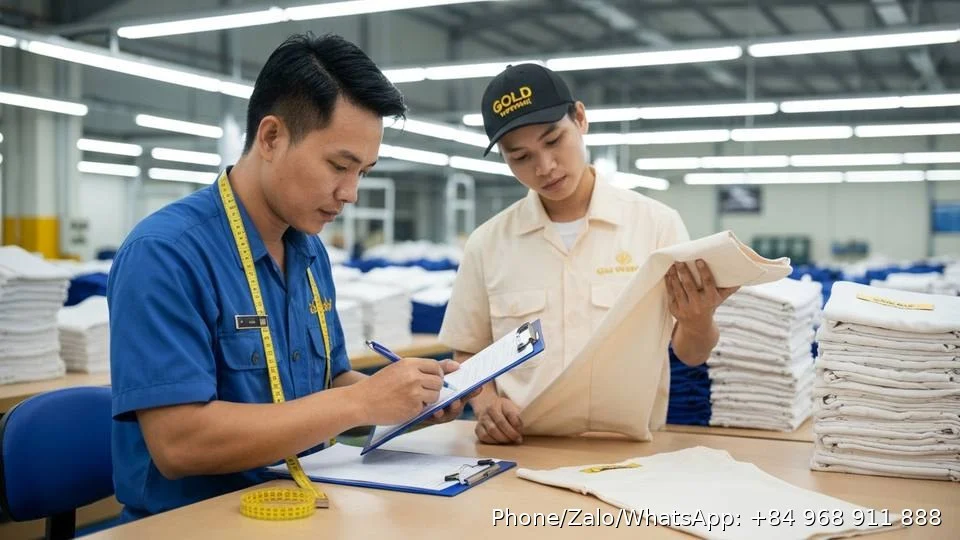
Maintaining high clothing quality control is non-negotiable, particularly for T-shirts where comfort and durability are key. As a BSCI-compliant factory with ISO-aligned quality management, Gold Garment implements rigorous quality control checkpoints throughout the entire production cycle:
- Incoming Material Inspection (IQC): Even though you supply the materials in a CMT model, we perform a visual and sometimes technical inspection of incoming fabric, threads, labels, and trims. This is to identify any obvious defects (e.g., fabric flaws, color variations, incorrect quantities) that could impact production quality. Any issues are immediately communicated to you.
- Cutting Inspection: Before and during cutting, pattern accuracy is verified. Checkpoints include:
- Correct pattern alignment with fabric grain.
- Accurate dimensions and shape of cut panels.
- Clean, precise cuts, free from frayed edges.
- Proper matching of striped or patterned fabrics.
- In-Line Production Checks (IPQC): Throughout the sewing process, quality inspectors routinely check garments at various stages:
- Stitch quality (evenness, tension, security).
- Seam integrity (no skips, puckering, or open seams).
- Correct assembly of components (sleeves, neckbands, side seams).
- Accurate label placement and attachment.
- Symmetry and alignment of garment parts.
- Final Random Inspection (FRI) / AQL Inspection: After garments are fully sewn, pressed (if required), and packed, a final inspection is performed on a statistically significant sample size based on AQL (Acceptance Quality Limit) standards. This comprehensive check covers:
- Overall garment appearance and hand-feel.
- All measurements against the approved tech pack/sample.
- Verification of all decorations (print quality, embroidery density, placement).
- Absence of defects (stains, holes, fabric flaws, loose threads, skipped stitches).
- Correct labeling, packaging, and carton marking.
These stringent checks ensure that every T-shirt leaving our facility meets your brand's standards and our commitment to excellence.
Navigating Sourcing: Understanding CMT vs FOB Clothing Models
For B2B buyers, choosing between CMT and FOB (Free On Board) models is a strategic decision that impacts cost, control, and complexity. Understanding CMT vs FOB clothing is essential for optimizing your Vietnam garment manufacturing strategy.
- CMT (Cut, Make, Trim):
- Buyer Responsibilities: Sourcing, purchasing, and supplying all raw materials (fabric, trims, labels).
- Factory Responsibilities: Pattern making (optional, if provided), cutting the supplied materials, sewing the garment, attaching trims, packaging.
- Advantages: Greater control over material quality and cost, potentially lower unit manufacturing cost from the factory, ideal for buyers with established material supply chains or unique fabric requirements. Faster turnaround if materials are readily available.
- Disadvantages: Requires significant internal sourcing expertise and management, higher risk if materials are delayed or defective, requires capital tied up in raw materials.
- Best For: Established brands with strong sourcing departments, buyers seeking specific or proprietary fabrics, and those looking to maximize control over their supply chain.
- FOB (Free On Board):
- Buyer Responsibilities: Providing design specifications and tech packs, approving samples.
- Factory Responsibilities: Sourcing all raw materials, pattern making, cutting, sewing, trimming, packaging, and arranging delivery to the port of origin.
- Advantages: "Turnkey" solution, less management burden for the buyer, simpler accounting, often preferred by smaller brands or those new to international sourcing. Reduced risk related to material sourcing.
- Disadvantages: Less control over material selection and cost, potentially higher unit price (as material costs are built-in), reliance on factory's sourcing network.
- Best For: New brands, buyers seeking a full-package solution, those with limited sourcing capabilities, or a desire for simpler logistics.
At Gold Garment Vietnam, we offer both full-package OEM (Original Equipment Manufacturer) and ODM (Original Design Manufacturer) production, allowing you the flexibility to choose the model that best fits your business needs. While this guide focuses on what does CMT mean, our comprehensive services mean we can adapt to your preferred approach, whether it's CMT or FOB.
Frequently Asked Questions
What exactly does CMT mean in the garment industry?
CMT stands for "Cut, Make, Trim." In this production model, the buyer is responsible for sourcing and providing all raw materials (fabric, threads, labels, etc.), while the factory provides the labor and machinery to cut the materials, sew them into finished garments, and apply all necessary trims and packaging.
How does a CMT garment factory operate in Vietnam?
A CMT garment factory in Vietnam, like Gold Garment, operates by taking your supplied raw materials and tech packs (design specifications). We then execute the cutting, sewing, and trimming processes with precision and efficiency. Our role is to transform your materials into high-quality finished garments, adhering strictly to your design, quality standards, and delivery schedule. We manage the skilled labor, machinery, and quality control throughout production.
What are the main advantages of choosing CMT vs FOB clothing for my T-shirt orders?
Choosing CMT offers greater control over your material sourcing, allowing you to select specific fabrics and negotiate costs directly. It can result in a lower factory unit price for the production service itself. This model is ideal for buyers with established supply chains or those requiring very specific, proprietary materials. FOB, in contrast, is a more 'turnkey' solution where the factory handles material sourcing, simplifying the process for the buyer but potentially offering less material control.
What raw materials do I need to supply to a CMT factory?
For T-shirt production under a CMT model, you would typically need to supply the main body fabric (e.g., cotton jersey, poly blend), ribbed fabric for neckbands, sewing threads (matching colors), woven labels (main brand label, care label), hang tags, and any specific embellishments like patches or special buttons. Essentially, everything that makes up the final garment.
Can Gold Garment Vietnam handle custom T-shirt designs under a CMT model?
Absolutely. Gold Garment specializes in custom cut-and-sew garments. Under a CMT model, you provide your specific T-shirt designs, tech packs, patterns, and all raw materials. Our experienced team then expertly cuts, sews, and trims your T-shirts to your exact specifications, ensuring your unique designs are brought to life with precision and high quality, from sampling to bulk production.
Ready to get started on your next T-shirt collection? Send us your specifications and we will respond with a detailed quote within 24 hours. Contact Gold Garment – no obligation.


